
Arctic Shipping
The Royal Dutch Navy's Strategic Dilemma on the Northern Sea Route
By A. Runhaar
Abstract
The increasing accessibility of the Northern Sea Route (NSR) presents a profound geopolitical and economic challenge for Europe. While the NSR offers potential trade benefits, its inherent risks—including dependence on Russia and heightened Arctic security concerns—cannot be ignored. This paper argues that a robust and cohesive Royal Dutch Navy Arctic Strategy is urgently required to safeguard Dutch interests and respond to the growing strategic competition in this critical maritime domain.
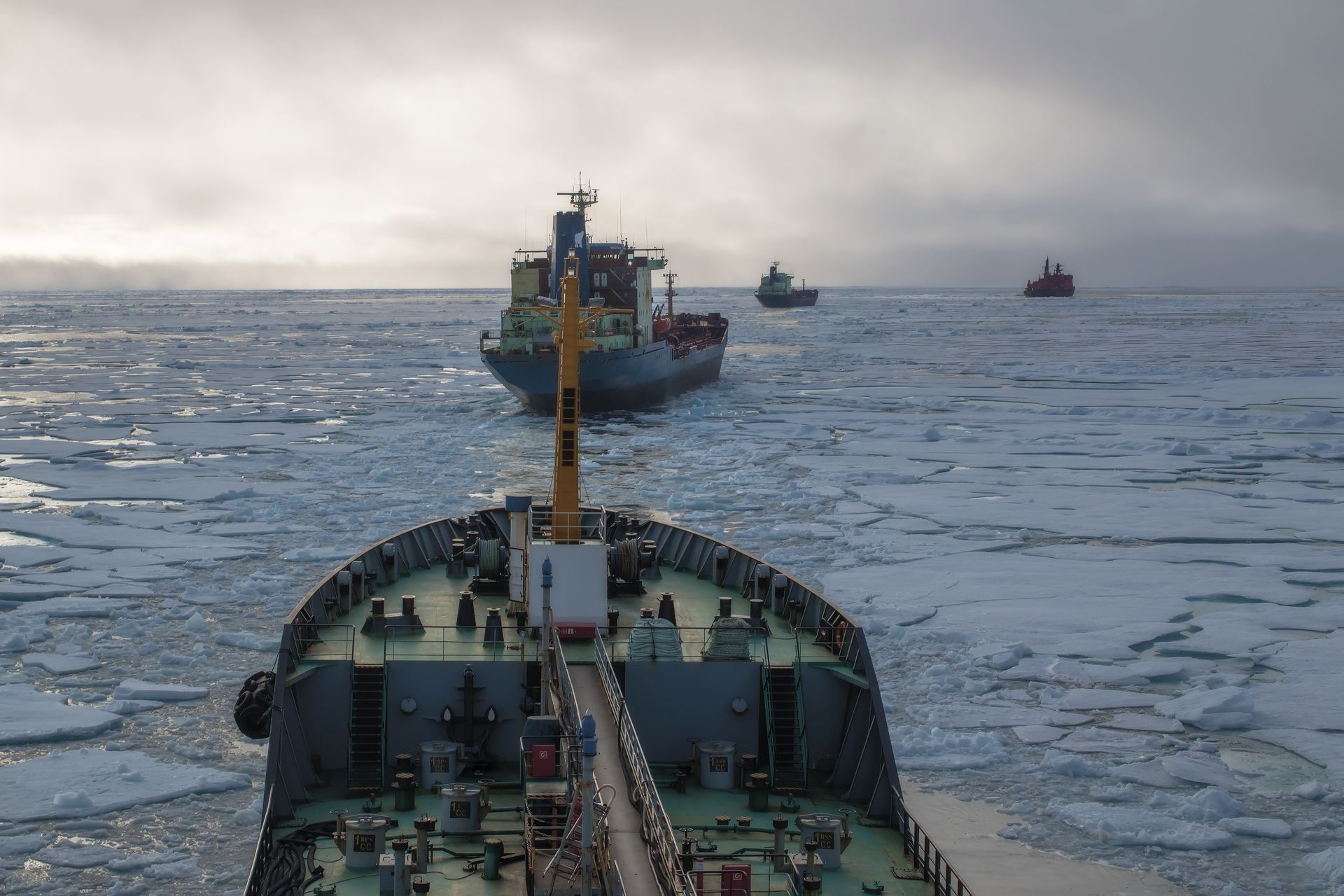 Commercial ships along the North Sea Route (photo: Shutterstock | 751962082)
Introduction
Over the past decade, the Arctic has attracted increasing attention from various global actors. The second Trump administration emphasises its interest in Greenland on a daily basis, while on the other side of the globe, Russia's Northern Fleet remains one of the most active and biggest naval forces in the arctic. This harbours important implications for how the Netherlands can and should pursue their strategic interests in this region.
Dutch Interest in the Arctic
The Arctic is the focus of the Foreign Office's Polar Strategy 2021-2025 as well as the recent Defence White Paper 2024. This increased attention is largely due to the economic potential of the Arctic, including opportunities in research, resource exploitation and the future accessibility of new trade routes. Beyond and through economic considerations, however, a critical new dimension has emerged: security. The Polar Strategy initially emphasized maintaining regional stability through multinational cooperation, while recognizing Russia's plans to modernize its Northern Fleet and China's growing interests in the Arctic. In contrast, the 2024 Defence White Paper takes a more security-oriented approach, influenced by the ongoing war in Ukraine. It emphasizes the importance of strengthening anti-submarine warfare capabilities, particularly to counter the Northern Fleet, and explicitly links these efforts to Arctic security. The document also emphasizes the escalating strategic competition in the region and frames NATO's role as one of deterrence and defence against Russian activities.
Given all the possible security risks, the economic value associated with a stable region and security nexus needs to be analysed more closely. Are the Arctic economic prospects worth taking this increasing security risk? This article examines the economic prospects of the trade routes and the acquisition, operational and geopolitical dilemmas that come with it.
Economic viability of the Northern Sea Route
While there are ambitious visions of future trade routes directly through the Arctic Ocean or making the Northwest Passage fully navigable, the Northern Sea Route (NSR) is the first to become viable and is already partially annually operational. Trade volumes along the route increased by 755% between 2014 and 2022.[i] From January to September 2024, it is estimated that 2.38 million tons of transit cargo was transported via the NSR, but with 95% of the cargo volume going from Russia and China.[ii] Despite the ongoing war in Ukraine and Western sanctions, shipping along the NSR has, therefore, reached new heights, driven largely by LNG transits. However, as of November 2024, the vision of the NSR as a single major international transit corridor between Asia and Europe remains unrealized since not a singular of these transits happened in 2024.
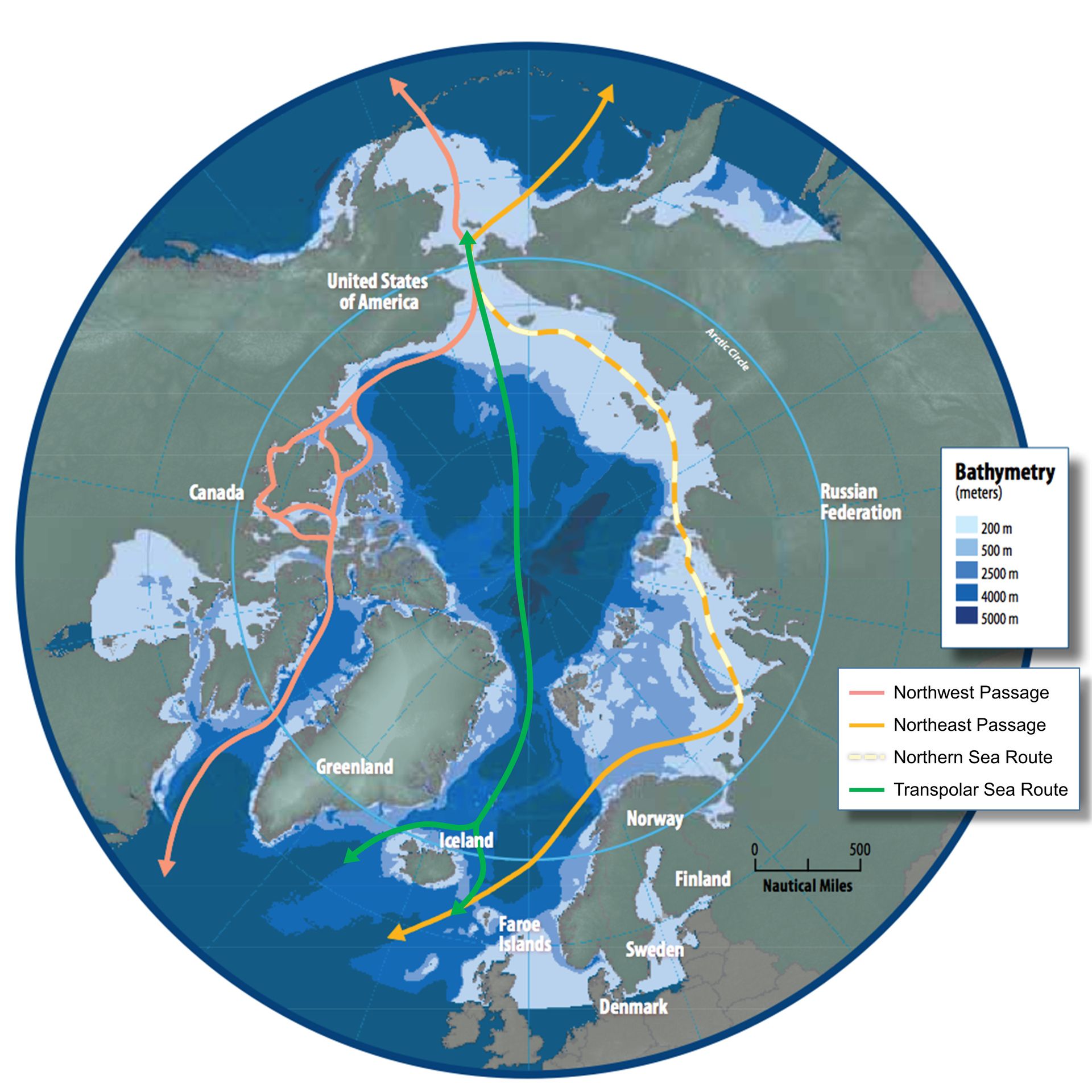
The future potential as an international transit route is, however, questionable. It is true that a voyage between the ports of Rotterdam and Yokohama can save up to seven days in transit time compared to the Suez Canal route, which can reduce fuel usage by up to 20%.[iii] In addition, vessels using the NSR can use slow steaming or super-slow steaming to achieve similar fuel savings and lower emission, therefore reducing climate impacts, while not going over existing travel times through the Suez.[iv] However, these benefits of the NSR diminish for more southern destinations. For voyages to Shanghai, the travel time is reduced to about two days. In the case of trade with destinations in the Hong Kong port, using the NSR actually increases transit times compared to the traditional route through the Strait of Malacca.[v] This variability in travel times and therefore highlights the importance of looking at specific origin-destination pairs when assessing the potential benefits of the NSR.
‘The future potential as an international transit route is questionable’
Acquirement Factors
Regarding the requirements for navigating the NSR: unlike standard cargo ships, which can navigate most global routes without special modifications, ships operating in the NSR must meet specific criteria set out in the International Maritime Organisation's Polar Code.[vi] This code sets strict safety and environmental standards for polar shipping. Building vessels capable of navigating the NSR is significantly more expensive due to the need for specialized upgrades. A key modification is the strengthening of the hull to withstand the harsh Arctic conditions, including the effects of thick ice and extreme cold. These ice-strengthened hulls, often classified in Ice Classes, require additional steel plating and advanced structural design to ensure durability and safety. This also increases the weight of the vessel and can hamper cost efficiency.
Next to construction costs, insurance costs are also a factor. Due to the reduced proximity to maritime infrastructure and rapidly changing weather conditions, the risks are much higher than when operating in temperate waters. Some insurance companies charge up to 40% more to their basic premium, just to insure a one-time journey.[vii] Even with insurance coverage, it cannot be guaranteed that a rescue of a vessel along the NSR is possible. The risk of an accident in this region poses significant challenges. The harsh environment makes rescue operations nearly impossible. The narrow operational window between severe weather events, coupled with the limited maritime infrastructure, severely restricts emergency response capabilities, often rendering the recovery of a stranded or damaged ship unfeasible. This was demonstrated by the removal of the Northguider wreck, a fishing vessel in the proximity of Svalbard, which took nearly two years.[viii]
Operational Dilemmas
If a ship is already equipped to operate on the NSR, there are several hurdles that make the journey more difficult. The first challenge is the communication along the coast. Strong winds can severely disrupt shortwave and VHF communications. Geostationary satellites in the region are often so low or even below the horizon at these high latitudes that a stable connection is not always guaranteed. This is especially relevant for future routes going through the Arctic Ocean. Norway, in connection with the US Space Force, is trying to close this gap for its military, via their Arctic Satellite Broadband Mission,[ix] but the problem for civilian operations still stands.[x]
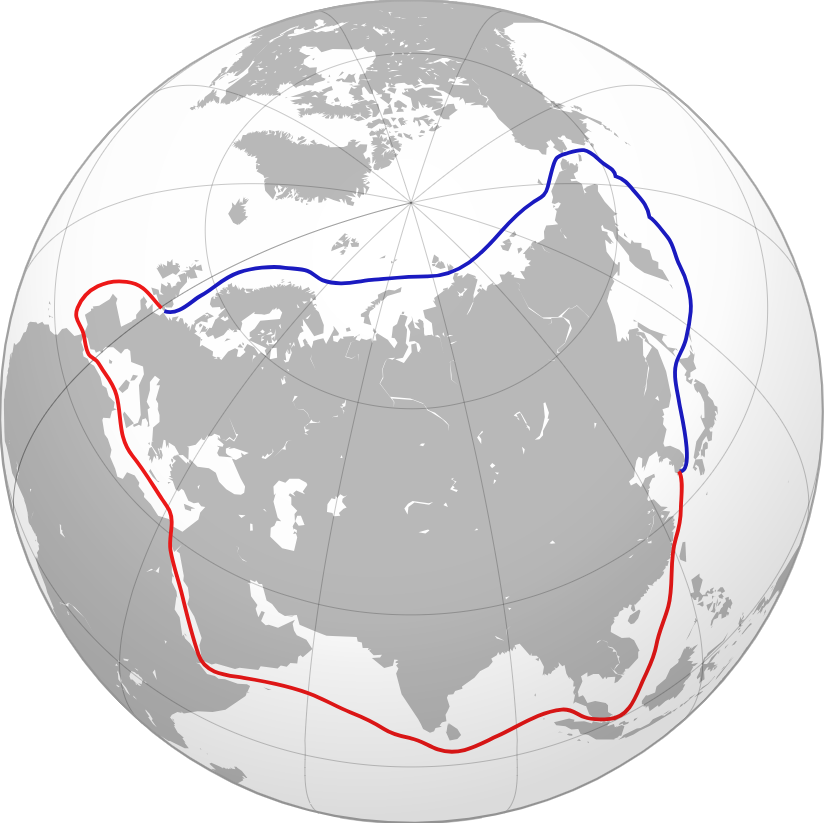 The Northeast Passage (blue) and an alternative route through the Suez Canal (red) (photo: Wikipedia)
In addition to reliable communication, effective navigation is essential for operating along the route. While the Northern Sea Route is better mapped than the Northwest Passage, access to detailed and up-to-date navigational data is managed by the Russian authorities. Vessels navigating the NSR must maintain frequent communication with these authorities as the route conditions can change abruptly. For example, monitoring ice thickness relies heavily on Russian icebreakers to track and manage changing ice conditions. Normally used systems, such as the Electronic Navigational Chart, do not cover the entire route, so alternative navigation systems are required.[xi] Dangerous weather, unpredictable currents and rapidly changing ice thickness naturally alter the NSR, adding complexity to navigation and potentially further reducing the time and cost-saving benefits of the route. Depending on the size of the container ship, the bathymetric conditions along certain parts of the NSR make the water too shallow.[xii] As a result, some ships, either because of the size of the container ship itself or because of natural obstacles, avoid these areas to avoid running aground.
In the event of an accident or maintenance, the sparse maritime infrastructure poses an additional challenge. Although there are five ports along the NSR, the maritime infrastructure is not as dense as in other regions. In addition to the weather conditions, SAR and emergency responses are therefore more difficult, including longer response times. Resupply options are also limited, not to mention port capabilities for advanced repairs, or ship handling capabilities.
‘Monitoring ice thickness relies heavily on Russian icebreakers to track and manage changing ice conditions’
The operationality along the route, therefore, depends mainly on Russian authorities alongside Russian legal framework, which applies to the whole maritime domain independently of the Exclusive Economic Zone (EEZ), territorial or Internal waters status. To enter the NSR, vessels must submit for authorization from the national authorities at least fifteen working days prior to the date on which they intend to enter the NSR.[xiii] Furthermore, this framework typically includes the requirement to use the assistance of Russian icebreakers for additional fees. According to Moscow, these practices are aimed at preventing accidents and ensuring safe passage. Russia justifies these regulations on the “ice” Article 234 of the United Nations Convention on the Law of the Sea (UNCLOS), according to which coastal states have the right to enforce laws targeting the prevention, reduction and control of marine pollution from vessels in ice-covered areas within the EEZ.[xiv]
However, even when European countries would be allowed to ship via the NSR, the proximity to the Russian coast poses a significant risk. With cyber-attacks increasing in the Barents Sea,[xv] merchant shipping is likely to be targeted by cyber-espionage, such as port scanning. Protection along the NSR with dedicated national military vessels will be almost impossible, as the Russian legal framework requires special diplomatic clearance even for innocent passage. Other protection through deterrence, such as a NATO Maritime Standing Group, remains unlikely due to the specialized capabilities required to operate in these icy conditions and the limited preparedness of many member states for such environments.
Geopolitical Dilemma
Given the impact a closure of a maritime chokepoint poses, as recently demonstrated in the Red Sea and Suez Canal, a diversification of trade route options makes sense. Compared to the current route of Dutch merchant vessels via the Cape of Good Hope, the NSR could pose a viable option when considering the potential time and cost benefits. When looking at part of the cost factors, some Dutch companies have already acquired suitable ships for sailing through the NSR, but, apart from the ongoing problems using this route, the Dutch shipping industry would be dependent on Russia and its regulation. Russia's Anti-Access/Area Denial (A2/AD) capabilities over the Northern Sea Route grant it leverage over the Dutch economy. This opens the discussion whether Moscow would partially or completely close the NSR for international transits in the future. Although a complete closure of the NSR would damage Russia's own economy, the recent war in Ukraine has demonstrated that the Kremlin may be willing to take such a step. More likely, however, would be the restriction or denial of passage for selected companies. This practice would indeed violate UNCLOS non-discriminatory rules for shipping, however seeing Russia's legal framework and the necessity of Russian permits to enter the NSR, such a practice could be possible.
It is also important to assess the future trajectory of shipping. Russian restrictions on European companies, trading between Europe and Asia, are plausible, potentially making the use of the Northern Sea Route (NSR) risky for European nations. However, it is unlikely that the Kremlin would restrict China's access to the NSR given the growing strategic partnership between the two countries.
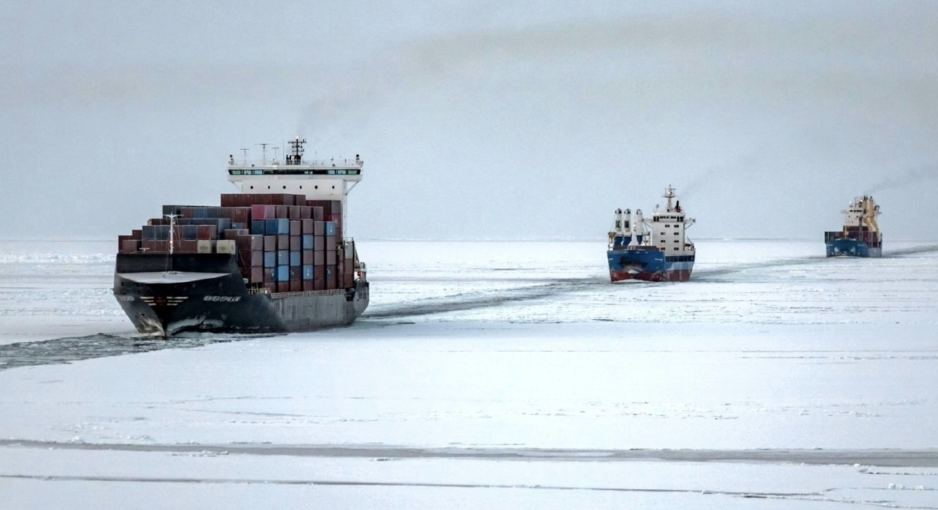 In 2023, the New Shipping Line of China carried out seven container ship voyages between Asia and Europe via the Arctic Ocean (photo: Rosatom)
This means two things: First, China could avoid its current security dilemma around the Strait of Malacca, also known as the Malacca Dilemma. As the Strait of Malacca is currently one of the world's busiest SLOCs, the blockade could have economic consequences. As the US is currently able to do so, Beijing would bolster its naval capabilities and economy if it were able to transit through the Northern Sea Route. This would also lead to a power shift in the South China Sea as a whole, as China would no longer, or to a lesser extent, have to consider its own economic prospects as the threat of blockade diminishes. For the Royal Netherlands Navy and other navies, this would lead to the need to further increase their presence in the region to compensate for the loss of deterrence and possibly find new pressure points for the People's Liberation Army Navy of China (PLAN). Secondly, through its relationship with Moscow, Beijing is not facing the same risk as European countries in using the NSR and is more likely to reap more of the positive benefits of this route.
Outlook
Looking at the economic values that underpin the viability of the NSR, the route is unlikely to become the new ‘Suez’. It is an interesting alternative, especially to the route around the Cape of Good Hope, but realistically all shipping will be dependent on Russian politics, and one could cynically say that the NSR is the New Malacca Dilemma for Europe with the slight difference that Europe can always fall back on the now standing route through Suez. Spontaneous changes, such as selective access restrictions requiring a sudden switch to the Suez Canal route, would still incur significant additional costs. The Netherlands should proceed with caution when dealing with NSR shipping. Some problems will naturally resolve themselves, for example the short annual access period will eventually be prolonged by climate change, others like the security dilemmas can increase. Realistically, there will be more transit through the NSR as it is more advantageous for China due to less dependency on Western maritime infrastructure. Whether it will be the same for international transits from Europe to Asia remains to be seen.
'The Royal Netherlands Navy must play a central role in this strategy, as the future of the Arctic will be shaped primarily in the maritime domain’
This means for the military security, firstly, that the Dutch military must present itself as new economic ventures flourish in a new region, be it for the protection of SLOCs. Secondly, it has to face all the operational dilemmas with limited resources in a region that is not the country's primary front. Thirdly, in the face of a disappearing natural barrier between NATO’s and Russia’s border, it must be able to invoke Article 5 in the Arctic. While it’s not necessary to face these challenges alone, and the Dutch are already involved in efforts to overcome operational challenges such as communication through their participation in the NORTHLINK initiative and different exercises like Steadfast Defender, the military has to tread carefully.[xvi] Brussels own position on the Arctic is not clear, given Canada's disinterest in NATO's involvement in the region, and the European Northern countries with a wish for bigger NATO engagement under their lead on the other side. US interest in Greenland further intensifies the situation, as it is testing NATOs strength. The Hague must therefore strike a balance between relying on NATO as the cornerstone of Arctic security and engaging with other defence frameworks that do not have this exact internal fragmentation, such as the European Union, or broaden regional groupings such as the Nordic-Baltic Eight, where Central Europe does not play a role yet.
The new polar strategy must first respond to the new global situation, with the second Trump administration and the war in Ukraine. However, instead of dealing with isolated issues, the strategy should treat the Arctic as a single, interconnected maritime domain and develop a phased approach to climate adaptation in response to its increasing accessibility due to climate change. It should not only follow the Dutch White Paper on Defence 2024 in increasing ASW capabilities to deter Russia but also provide clear guidance on US interests in Greenland. This could bring the Nordic countries and the Netherlands even closer together. The Royal Netherlands Navy must play a central role in this strategy, as the future of the Arctic will be shaped primarily in the maritime domain.

Noten
[i] 'How viable is Arctic shipping?', The Economist, june 28th 2024, see: https://www.economist.com/the-economist-explains/2024/01/18/how-viable-is-arctic-shipping
[ii] Centre for High North Logistics (2024): Overview of transit navigation on the NSR, Update 30 September 2024, Accessed 01.11.2024
[iii] Wergeland, Tor (2010), Arctic Shipping Routes - Cost Comparisons with Suez, Arctis Knowledge Hub, Accessed 23.11.2024
[iv] Willige, Andrea (2024): Why the Red Sea shipping crisis will raise CO2 emissions, World Economic Forum, Accessed 03.11.2024
[v] Humpert, Malte (2011): The Future of the Northern Sea Route - A “Golden Waterway” or a Niche Trade Route, Arctic Institute, Accessed 23.11.2024
[vi] International Maritime Organization (2015): International Code for Ships Operating in Polar Waters, Accessed 20.02.2024 International Code for Ships Operating in Polar Waters (Polar Code)
[vii] International Union Marine Insurance (2020): Things to ponder for insurers as Arctic routes open up, Accessed 12.11.2024
[viii] Steen, Hermann: Maritime casualties in the High North, Wikborg | Rein, Accessed 19.11.2024
[ix] Northrop Grumman: Arctic Satellite Broadband Mission, Accessed 23.11.2024
[x] European Space Agency: Arctic poses communications challenges, Accessed 23.11.2024
[xi] OCIMF (2017): Northern Sea Route Navigation, Accessed 23.11.2024
[xii] van Hussen, K. et al. (2020), Commercial Navigation Along the Northern Sea Route: Prospects and Impacts, International Transport Forum Discussion Papers, No. 2020/19, OECD Publishing, Accessed 23.11.2024
[xiii] Schönfeldt, Kristina (2017): The Arctic in International Law, Oxford Hart Publishing.
[xiv] United Nations, United Nations Convention on the Law of the Sea, 10 December 1982, Article 234, Accessed 14.11.2024
[xv] Blair, Alex (2024): Will the Northern Sea Route become commercially viable in the near future?, In Ship Technology Feature, Accessed 23.11.2024,
[xvi] NATO (2024): NATO launches five new multinational cooperation initiatives that enhance deterrence and defence; Accessed 31.03.2025, NATO - News: NATO launches five new multinational cooperation initiatives that enhance deterrence and defence, 17-Oct.-2024
Gerelateerd

Tri-marines: vertrouwde en interoperabele partners op het slagveld
Het Korps Mariniers kent een lange geschiedenis en voelt een sterke verbintenis met amfibische families bestaande uit vele bevriende…
The future of Transatlantic relations
In the coming years, the key in the transatlantic relations lies to sail as close to the wind as possible between total commitment and…

Europe's Maritime Challenges Examined
From 6 to 8 April 2025, fourteen international academics and naval professionals gathered in Rotterdam to examine the strategic challenges…

