
Europe should act before it's too late
U.S. shift to transactional foreign policy affects Russian military strategy
By KLTZ RLNL L.H. ter Veen
Abstract
The recent shift in U.S. foreign policy towards a transactional zero-sum approach, especially following the Trump administration's open rapprochement with Russia, effectively ends decades of conventional containment. This profound change directly enables Russia's military strategy and poses a severe threat to European security. This analysis, by Commander Sjors ter Veen, identifies the aggressive nature of Russian strategy and details why Europe must immediately respond through credible force generation and its own nuclear deterrence capabilities before Russia capitalizes on NATO's destabilization.
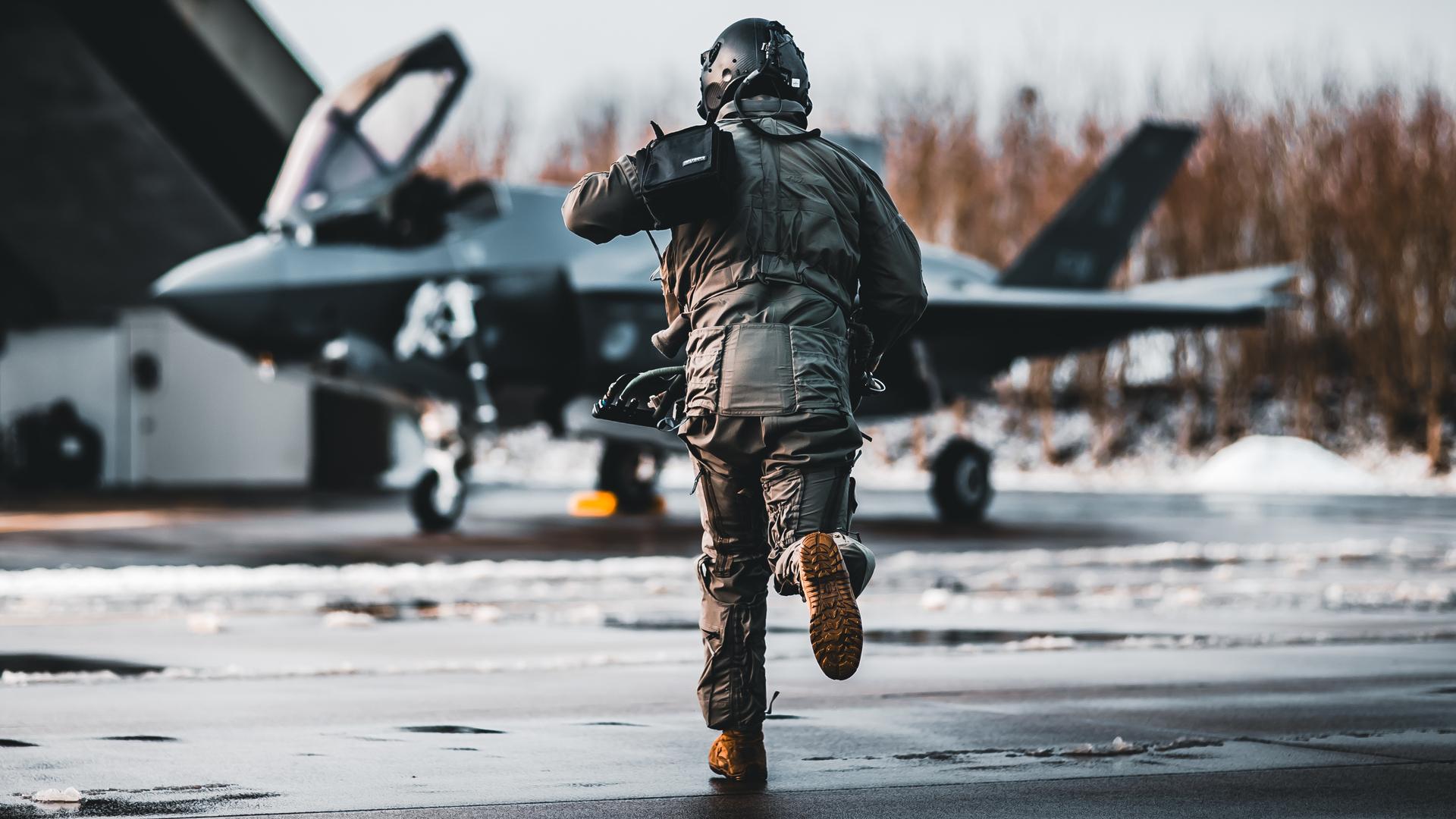 322 Squadron practices deployment readiness with the F-35 Quick Reaction Alert, Leeuwarden, December 4, 2023 (photo: MCD)
Introduction
U.S. foreign policy was traditionally based on the containment approach. Since coming into power, the Trump administration has actively broken with this policy by openly seeking an ease of tensions with Russia.[i] President Trump, who is characterized by his transactional zero-sum line of operation[ii], appears to have altered U.S. foreign policy, de facto ending the conventional containment policy that marked Western hegemony for decades. Recent U.S. pragmatic rapprochement towards the Kremlin could have profound impact on Russia’s military strategy and endanger European security. This article will first identify Russia’s military strategy, followed by an explanation of the likely effect of recent U.S. foreign policy shift on Russia’s military strategy. It will conclude by answering how Europe should respond to safeguard its security.
Identifying Russian Strategy
Russian strategic culture reasons out of vulnerability and fear for external attack based on four narratives; vulnerability of long borders; lack of strategic depth; a deep-seated sense of insecurity vis-à-vis the West and the West’s alleged machinations and techniques to remove pro-Russian leaders in neighbouring states.[iii]Russian strategic culture is characterized by a feeling of superiority; the deep belief of being a great nation state from which it derives the right to have a sphere of privileged interests.[iv] Russian military strategy is derived from its strategic culture and can be identified as follows. It is to safeguard Russian influence in what Moscow considers to be it’s ‘near abroad’ and to deny influence of other (non) state actors, notably NATO[v], by the use of soft and hard in such – more often than not – obscure ways that Russia has prevalence of its adversary.[vi] Russia successfully achieved its objectives of annexing the Crimea by virtue of conflating ‘deniable’ special forces, local armed actors, economic clout, disinformation, and exploitation of socio-political polarisation in Ukraine.[vii]
Although there is no universally accepted definition of hybrid warfare, Frank Hoffman defined it as ‘the emerging simultaneous use of multiple types of warfare by flexible and sophisticated adversaries who understand that successful conflict requires a variety of forms designed to fit the goals at the time’.[viii] To fit Moscow’s approach in the West’s paradigm of war and peace, which in Russia’s military strategy is much less clear, NATO further defined the definition of hybrid warfare:
‘Hybrid warfare is the creative use of hard, soft, and smart power by malign state and nonstate actors to achieve warlike objectives and political goals. Malign acts include a broad spectrum of military and non-military instruments of coercive power beyond the conventionally conceived multidomain battlespace. Hybrid warfare encompasses politics, diplomacy, information, the economy, technology, the military and society, as well as dimensions like culture, psychology, legitimacy and morale. The coordinated performance of these malign acts occurs both overtly and covertly in the ambiguous grey zones of blurred interfaces: between war and peace, friend and foe, internal and external relations, civil and military, and state and nonstate actors, as well as in fields of responsibilities generally below the threshold of war or as an accompaniment to more regular armed conflict.’[ix]
The Kremlin has shown it masters its performance in the ambiguous grey zones of interfaces and that it has the willingness and ability to use its full potential, including its full military potential, to achieve its foreign policy objectives. Since 1991, Moscow has undertaken no less than twenty-six military interventions.[x]Thus, an aggressive military intervention strategy to prevent erosion of influence in its ‘near abroad’ corresponds with Russia’s great power thinking.
'An aggressive military intervention strategy to prevent erosion of influence in its ‘near abroad’ corresponds with Russia’s great power thinking’
The effect of U.S. shift to a transactional foreign policy
Only Western dominance through its containment policy has restrained Russia in the use of military power to bring back NATO member sovereign states, considered by Moscow as their ‘near abroad’.[xi] With President Trump’s transactional America First foreign policy there is no doubt he moves away from Europe and international organisations, including NATO, thus threatening Western dominance.[xii] The writing on the wall of Washington’s movement away from Brussels could not emerge more clearly than out of the words of U.S. ambassador to NATO, Matthew Whitaker who announced in May that the America will start discussions about U.S. troop withdrawal from Europe later this year.[xiii] Trump’s active pursuit in rapprochement towards Russia in combination with his movement away from NATO, marks a profound change in American foreign policy and de facto ends its previous containment strategy.[xiv] Although the EU managed to continue a containment strategy towards Russia despite Trumps recent rapprochement, it remains to be seen for how long the EU will be able to remain united in that respect. Nationalist, illiberal, populist political parties are on the rise and threaten Europe’s containment strategy towards Russia. For example, from the very outset of Russia’s invasion of Ukraine in February 2022, Hungarian Prime Minister Viktor Orbán has systematically disrupted European decision-making.[xv]
 ‘Hungarian Prime Minister Viktor Orbán has systematically disrupted European decision-making’. Orbán and Putin during a press conference in 2017 (photo: Wikimedia Commons)
Moscow’s intervention politics avoided a direct military confrontation, for it perceived it could not win in a direct confrontation against a unified NATO under strong U.S. leadership.[xvi] Trump’s transactional America First policy ends a strong U.S. leadership and is likely to destabilize NATO’s unity. This directly affects Russian military strategy. First, the Kremlin might perceive that it’s threshold on which actions would lead to a confrontation with NATO has changed. Destabilization of NATO and a power vacuum in its leadership upon America’s withdrawal from that responsibility, may incline Russia to believe NATO’s resolve has diminished, thus changing the threshold for its response to the use of hard power. As a result, Moscow might resort to more use of subversive activities aimed at further disrupting Western societies and possibly even military action, to end Western hegemony in Russia’s near abroad. Second, if Washington decides it will no longer guarantee support for NATO, notably its nuclear deterrence, the restraint of prevention of conflict with NATO might be lifted altogether, since Russia would have advantage on nuclear escalation domination.
Its cautiousness to restrain the use of hard power which would trigger a NATO response, would no longer be necessary since Russia might assess it’s able to defeat a divided alliance under weak leadership. For example, Moscow, anticipating reluctant decision-making in NATO’s power vacuum, might decide upon a short intense military intervention to bring back the Baltic States in their sphere of influence, expecting to confront NATO with a fait accompli. Military expert and professor of international relations at the University of Munich Carlo Masala elaborates about precisely this scenario in his international bestseller ‘If Russia wins’ (2025).
‘European security is in danger’
Europe’s Necessary Response
European security is in danger. Prior to Russia’s invasion in Ukraine, it was a wide held belief that Moscow did not pose a military threat to NATO.[xvii] However, their aggression has shown its determination to restore its influence. The Trump administration’s transactional America First policy may lead to Russia’s belief it is no longer restrained in the use military force to bring back lost territory within its sphere of influence. Europe should therefore use whatever time available before the Kremlin has the chance to capitalize on the recent shift in U.S. foreign policy. This can be done under strong European leadership with leading roles for the United Kingdom, France and Germany. It requires 1) immediate credible force generation, 2) risk mitigation by France and the United Kingdom to Russia’s nuclear escalation advantage, 3) aggressive actions against Russian subversive activities and 4) a resilient European continuation of containment policy vis-à-vis Russia.
- immediate credible force generation
Early 2025, Washington had eighty-four thousand troops in Europe, primarily from the Navy, Air Force and Army, operating from over forty different bases. These troops constituted, besides a significant conventional force, a nuclear force believed to have a strength of roughly one hundred B-61 nuclear bombs.[xviii] Europe should generate a force equivalent in strength and capacity to be able to maintain status quo vis-à-vis Russia when the U.S. decides to withdraw conventional capabilities and forces from Europe. It is the present status quo that has withheld Russia from a direct military confrontation[xix] and Europe cannot afford to lose military power in such a way that it will endanger the present status quo.
 President Macron stated in March that France’s nuclear deterrence plays a role in the preservation of peace and security in Europe. Macron during the NATO summit in Vilnius, 2023 (photo: G. Ivuskans | Shutterstock)
- risk mitigation by France and the United Kingdom to Russia’s nuclear escalation advantage
The NATO Nuclear Deterrent factsheet states that the alliance particularly relies on U.S. strategic nuclear forces. Furthermore, a select group of European NATO member states can deliver U.S. nuclear weapons deployed in Europe, based on nuclear-sharing arrangements, whilst Washington always maintains full custody of these weapons. As for the independent strategic nuclear forces of the UK and France, the factsheet mentions they have a deterrent role of their own.[xx] Nuclear deterrence can help ensure strategic competition remains confined to the lower end of conflict.[xxi] Europe therefore should be able to provide a credible nuclear deterrence of its own in case the Trump administration decides to withdraw this capability. Previous French presidents have already stated that the strategic nuclear deterrence of France has European dimensions and president Macron stated in March that France’s nuclear deterrence plays a role in the preservation of peace and security in Europe.[xxii] It is time to further materialize on France’s commitment towards Europe and Europe should include the United Kingdom in that quest.
- aggressive actions against Russian subversive activities
Russia’s escalation of its shadow war indicates a Western failure to properly respond. Europe has focussed on diplomacy and defensive measures to deter or counter Russian actions and by doing so has failed to impose sufficient costs on Moscow.[xxiii] Europe should coercively respond to Russian subversive activities in such an offensive aggressive manner that for Russia the costs of its escalation in its shadow war against Europe no longer outweigh the benefits.
- a resilient European continuation of containment policy vis-à-vis Russia
Professor of international relations and founder of The Hague Centre for Strategic Studies Rob de Wijk argues that Europe, after thirty years of neglect, has lost its ability for power politics; a skill that is of the utmost importance to master in a time where the international balances of power are searching for a new equilibrium.[xxiv] To defend the interest of Europe and safeguard its security, a European continuation of a resilient containment policy vis-à-vis Russia is therefore essential.
If Europe succeeds in addressing the aforementioned issues, it will not only be able to maintain present status quo, it will also provide Europe the opportunity to present the Trump administration a zero-sum deal where the U.S. must choose between Europe and Russia. From Trump’s transactional perspective Europe would remain its preferred partner, enabling the West to continue its security policy albeit in a more transactional way.
Written in a personal capacity by Lambert Henk (Sjors) ter Veen, Commander Royal Netherlands Navy.

Noten
[i] Hasim Turker. 2025. “Trump’s Russia Strategy; Breaking the Sino-Russian Alliance or Strengthening it?” Geopolitical monitor. https://www.geopoliticalmonitor.com/trumps-russia-strategy-breaking-the-sino-russian-alliance-or-strengthening-it/ (consulted 21. February 2025)
[ii] Ravi Agrawal. 2025. “Trump is Ushering in a More Transactional World”. Foreignpolicy.com. https://foreignpolicy.com/2025/01/07/trump-transactional-global-system-us-allies-markets-tariffs/ (consulted 21. February 2025)
[iii] Elias Götz and Jorgen Staun. 2022. "Why Russia attacked Ukraine: Strategic culture and radicalized narratives," Contemporary Security Policy 43:3 (2022), pp.482-497. Accessible at https://www.tandfonline.com/doi/epdf/10.1080/13523260.2022.2082633?needAccess=true(consulted 21. February 2025)
[iv] Elias Götz and Jorgen Staun. 2022. "Why Russia attacked Ukraine: Strategic culture and radicalized narratives," Contemporary Security Policy 43:3 (2022), pp.482-497. Accessible at https://www.tandfonline.com/doi/epdf/10.1080/13523260.2022.2082633?needAccess=true(consulted 21. February 2025)
[v] John C Dewdney and Richard Turaskin. 2025. “Ethnic relations and Russia’s near abroad”. Encyclopaedia Brittanica. Accessible at https://www.britannica.com/place/Russia/Ethnic-relations-and-Russias-near-abroad
(consulted 21. February 2025)
[vi] Michael Kofman, Anya Fink, Dmitry Gorenburg, Mary Chesnut, Jeffrey Edmunds, Julian Waller. 2021. “Russian Military Strategy; Core Tenets and Operational Concepts”. Centre Naval Analysis. Accessible at https://www.cna.org/reports/2021/08/Russian-Military-Strategy-Core-Tenets-and-Operational-Concepts.pdf (consulted 22. February 2025)
[vii] Arsalan Bilal. 2021. “Hybrid Warfare – New Threats, Complexity, and ‘Trust’ as the Antidote”. NATO REVIEW. Accessible at https://www.nato.int/docu/review/articles/2021/11/30/hybrid-warfare-new-threats-complexity-and-trust-as-the-antidote/index.html(consulted 12. July 2025)
[viii] Frank Hoffman. 2007. “Conflict in the 21st Century: The Rise of Hybrid Wars”. Potomac institute for Policy Studies. Accessible at https://www.potomacinstitute.org/images/stories/publications/potomac_hybridwar_0108.pdf (consulted 12. July 2025)
[ix] Sean S. Costigan. Michael A. hennesy. 2024. “Hybrid threats and hybrid warfare reference curriculum”. NATO HQ Brussels. Accessible at https://www.nato.int/nato_static_fl2014/assets/pdf/2024/7/pdf/241007-hybrid-threats-and-hybrid-warfare.pdf (consulted 12. July 2025)
[x] Samuel Charap, Edward Geist, Bryan Frederick, John J. Drennan, Nathan Chandler, Jennifer Kavanagh. 2021. “Russia’s Military Interventions; Patterns, Drivers and Signposts”. RAND corporation. Accessible at https://www.rand.org/pubs/research_reports/RRA444-3.html(consulted 22. February 2025)
[xi] Dorsel Boyer. 2025. “Russian Tactics – How Russia Views The Strategic Environment”. ATP 7 – 100.1. Accessible at https://oe.tradoc.army.mil/2025/01/15/atp-7-100-1-russian-tactics-how-russia-views-the-strategic-environment/ (consulted 22. February 2025)
[xii] White House Briefings and Statements. 2025. “President Trump’s America First Priorities”. White House. Accessible at https://www.whitehouse.gov/briefings-statements/2025/01/president-trumps-america-first-priorities/ (consulted 22. February 2025)
[xiii] Andrius Sytas. 2025. “U.S. to start European troop withdrawal discussions later this year, U.S. NATO ambassador says”. Reuters. Accessible at https://www.reuters.com/world/us-start-european-troop-withdrawal-discussions-later-this-year-us-nato-2025-05-16/ (consulted 14. July 2025)
[xiv] Alexander B Gray. 2025. “Trump Will End U.S. Passivity in the Western Hemisphere”. Foreign Policy. Accessible at https://foreignpolicy.com/2025/01/13/trump-greenland-panama-canada-monroe-doctrine-geopolitics-western-hemisphere/ (consulted 22. February 2025)
[xv] Szuszanna Szelényi. 2024. “Orbán’s Rebellion Against Europe gains Momentum”. Carnegie Endowment for international Peace”. Accessible at https://carnegieendowment.org/europe/strategic-europe/2024/11/orbans-rebellion-against-europe-gains-momentum?lang=en (consulted 14. July 2025)
[xvi] Nicola Fasola. 2024. “Understanding Russia’s Military Strategy; The Pitfalls of Western Ethnocentrism”. Australian Institute of International Affairs. Accessible at https://www.internationalaffairs.org.au/australianoutlook/understanding-russias-military-strategy-the-pitfalls-of-western-ethnocentrism/ (consulted 22. February 2025)
[xvii] Mark Geleotti. 2019. “The Baltic States as Targets and Levers; The Role of the Region in Russian Strategy”.
European Centre for Security Studies. Security Insights. Accessible at https://www.marshallcenter.org/en/publications/security-insights/baltic-states-targets-and-levers-role-region-russian-strategy-0 (consulted 22. February 2025)
[xviii] Molly Carlough. Benjamin Harris. Abi McGowan. 2025. “Where Are U.S. Forces Deployed in Europe?”. Council on foreign relations. Accessible at https://www.cfr.org/article/where-are-us-forces-deployed-europe (consulted 14. July 2025)
[xix] Dorsel Boyer. 2025. “Russian Tactics – How Russia Views The Strategic Environment”. ATP 7 – 100.1. Accessible at https://oe.tradoc.army.mil/2025/01/15/atp-7-100-1-russian-tactics-how-russia-views-the-strategic-environment/ (consulted 22. February 2025)
[xx] Public Diplomacy Division NATO. 2020. “North Atlantic Treaty Organization factsheet on NATO Nuclear Deterrence”. Accessible at https://www.nato.int/nato_static_fl2014/assets/pdf/2020/2/pdf/200224-factsheet-nuclear-en.pdf (consulted 14. July 2025)
[xxi] Daniel Post. 2023. “The Value And Limits Of Nuclear Deterrence”. U.S. Naval Institute Proceedings. Accessible at https://www.usni.org/magazines/proceedings/2023/january/value-and-limits-nuclear-deterrence (consulted 14. July 2025)
[xxii] Emanuelle Maitre. 2025. “The French nuclear deterrent in a changing strategic environment”. Foundation pour la recherche stratégique. Accessible at https://www.frstrategie.org/node/9753 (consulted 14. July 2025)
[xxiii] Seth G. Jones. 2025. “Russia’s Shadow War Against the West”. Center For Strategic and international Studies. Accessible at https://www.csis.org/analysis/russias-shadow-war-against-west#h2-going-on-offense (consulted 14. July 2025)
[xxiv] Rob de Wijk. 2024. “Het Nieuwe IJzeren Gordijn”. Uitgeverij Balans.
Gerelateerd

Tri-marines: vertrouwde en interoperabele partners op het slagveld
Het Korps Mariniers kent een lange geschiedenis en voelt een sterke verbintenis met amfibische families bestaande uit vele bevriende…
The future of Transatlantic relations
In the coming years, the key in the transatlantic relations lies to sail as close to the wind as possible between total commitment and…

Europe's Maritime Challenges Examined
From 6 to 8 April 2025, fourteen international academics and naval professionals gathered in Rotterdam to examine the strategic challenges…

